One trade a week model – this model trades the QQQ and TQQQ once a week, based on the return variance analysis. In the past 50 years, QQQ tends to perform well in from Monday to Wednesday. This model goes long on Monday and exits before Friday.
March 2026 to April 2026 in action.
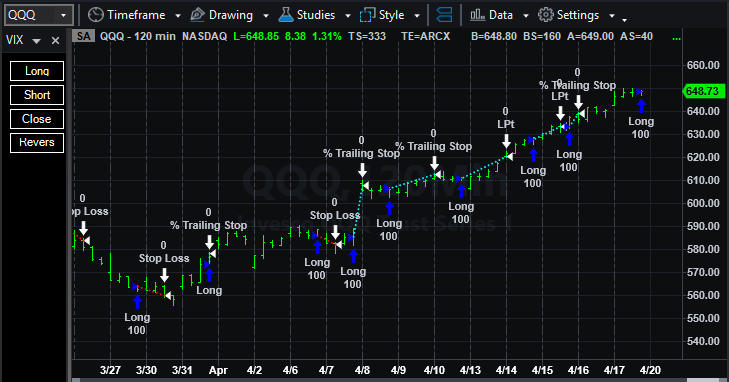
Our swing algo trades all markets using mathematics and statistics models. A modern class of trading systems that abandons traditional technical indicators and instead relies on pure mathematics, probability theory, and statistical modeling to understand and trade financial markets.
1. Introduction
Most conventional algorithmic trading strategies employ technical indicators such as moving averages, oscillators, or momentum metrics. While widely used, these indicators are typically deterministic transformations of historical price data and often introduce lag, redundancy, and parameter sensitivity.
Indicator-free trading algorithms adopt a fundamentally different perspective. Markets are treated as stochastic systems governed by probabilistic laws rather than heuristic signals. Trading decisions are derived from mathematically defined models that analyze price behavior directly, without intermediate indicator layers.
2. Mathematical Framework
2.1 Probability Theory and Stochastic Processes
Prices are modeled as realizations of stochastic processes rather than deterministic trends. Depending on the market and time scale, models may incorporate random walks, mean-reverting dynamics, regime-switching processes, or heavy-tailed distributions. This framework allows the explicit modeling of uncertainty, tail risk, and asymmetric outcomes.
2.2 Statistical Inference
Signal generation is based on statistical inference rather than pattern recognition. Hypothesis testing, likelihood estimation, Bayesian updating, and confidence intervals are used to determine whether observed price behavior deviates meaningfully from a null model. Trades are executed only when statistical evidence exceeds predefined significance thresholds.
2.3 Time Series Analysis
Instead of smoothing prices through indicators, these algorithms analyze intrinsic time-series properties such as autocorrelation, variance dynamics, stationarity, and structural breaks. Changes in these properties often precede regime shifts and are therefore central to model-based decision making.
3. Model Categories
Indicator-free trading systems commonly fall into several model families:
Mean-Reversion Models: Identify statistically significant deviations from equilibrium distributions and trade on expected reversion.
Trend Persistence Models: Estimate the probability of continuation based on transition dynamics rather than indicator crossovers.
Volatility Models: Forecast variance and higher-order moments to adjust exposure dynamically.
Regime Detection Models: Classify market states such as expansion, contraction, or transition using probabilistic state models.
Optimization and Control Models: Apply mathematical optimization to position sizing, execution timing, and capital allocation.
4. Risk Management
Risk management is embedded directly within the mathematical structure of indicator-free systems. Position sizing, leverage constraints, and exit conditions are derived from estimated loss distributions and risk metrics such as expected drawdown or tail probability.
As uncertainty increases, exposure is reduced automatically through model dynamics rather than discretionary rules. This leads to strategies that adapt continuously to changing market conditions.
5. Advantages Over Indicator-Based Approaches
Indicator-free algorithms offer several advantages:
Reduced lag and fewer arbitrary parameters
Explicit probabilistic interpretation of trading decisions
Greater robustness across market regimes
Clear separation between signal inference and execution mechanics
6. Conclusion
Indicator-free trading algorithms represent a disciplined, scientific approach to market participation. By relying on mathematical structure and statistical evidence rather than heuristic indicators, these systems seek consistency, interpretability, and scalability in complex and uncertain financial environments.